Back to Work

Development of the COVID-19 Vaccine: Advancing Global Health Through Clinical Research, Innovation and Data Integrity

The COVID-19 pandemic was one of the most significant public health emergencies in modern history, affecting millions of people across the globe and placing unprecedented pressure on healthcare systems. The rapid spread of SARS-CoV-2 highlighted the urgent need for safe and effective vaccines capable of protecting individuals and reducing the burden of severe disease. Although vaccine development traditionally requires many years of research, global collaboration, scientific innovation and robust clinical research enabled the development of COVID-19 vaccines within an accelerated timeframe without compromising patient safety or scientific integrity.

From the perspective of a Clinical Data Manager, the success of COVID-19 vaccine development extended beyond laboratory discoveries. It relied heavily on the generation, management and analysis of accurate, reliable and high-quality clinical data collected during every phase of clinical research. Every participant enrolled in a clinical trial contributed valuable information that enabled researchers, healthcare professionals and regulatory authorities to evaluate vaccine safety, efficacy and overall benefit-risk profiles.

This case study explores how international collaboration, evidence-based clinical research and innovative technologies contributed to the successful development of COVID-19 vaccines. It also demonstrates how ethical clinical trials, participant safety and robust Clinical Data Management supported regulatory decision-making, strengthened public confidence in vaccination programmes and improved healthcare outcomes worldwide.

Overview

COVID-19 transformed healthcare on a global scale. What began as a local outbreak rapidly evolved into a pandemic that affected every country, disrupting healthcare services, economies, education and everyday life. Hospitals experienced overwhelming numbers of patients requiring intensive care, while healthcare professionals worked under extraordinary circumstances to provide life-saving treatment.

In response to this unprecedented crisis, governments, pharmaceutical companies, biotechnology organisations, academic institutions and regulatory agencies united to accelerate vaccine research. Their shared objective was to develop vaccines that were scientifically proven to be safe, effective and suitable for widespread public use.

Clinical trials formed the foundation of this effort. They generated the scientific evidence required to demonstrate vaccine safety and effectiveness while ensuring participant rights remained protected throughout the research process. As a Clinical Data Manager, maintaining the quality, accuracy and integrity of this evidence was central to ensuring that regulatory authorities could make informed decisions based on reliable clinical data.

Understanding the Global Health Challenge

COVID-19 is an infectious respiratory disease caused by the SARS-CoV-2 virus. Due to its high transmissibility, the virus spread rapidly across continents, resulting in widespread illness, hospitalisations and significant mortality. Although many individuals experienced mild symptoms, others developed severe pneumonia, respiratory failure and life-threatening complications.

The pandemic created challenges beyond healthcare. Businesses closed, educational institutions transitioned to remote learning, travel restrictions were introduced and communities faced prolonged social and economic uncertainty. Healthcare systems struggled to maintain routine services while responding to increasing numbers of COVID-19 patients.

Vaccination quickly became the most effective long-term strategy for controlling the pandemic. However, developing vaccines against a newly identified virus required unprecedented scientific collaboration while maintaining rigorous research standards. Researchers needed to understand the virus, identify suitable vaccine technologies and conduct carefully designed clinical trials to establish safety and effectiveness.

Despite the urgency, ethical research principles remained unchanged. Every study followed internationally recognised Good Clinical Practice (GCP) guidelines, ensuring participant safety, informed consent and independent ethical oversight throughout the clinical development programme.

Research Approach

Case Study 1 — Global COVID-19 Surveillance Trends

A real-world COVID-19 surveillance analysis was conducted using WHO data from selected 28-day reporting periods in 2024. Reported global cases declined from 1.1 million (Dec 2023–Jan 2024) to 275,000 (Mar 2024), before increasing to 330,000 (Sep–Oct 2024). During Sep–Oct, approximately 25,000 hospitalisations and 800 ICU admissions were reported. WHO also reported that ICU admissions per 1,000 hospitalisations declined from a peak of 245 in July 2021 to 108 by early November 2024, while deaths per 1,000 hospitalisations declined from 253 in June 2021 to 41 by early November 2024. This demonstrates the value of analysing infection trends alongside clinical outcomes.

Line chart of selected WHO-reported global COVID-19 case counts across four 2024 reporting periods, declining from around 1.1 million in Dec 2023-Jan 2024 to a low of around 185,000 in Jul 2024, then rising to around 330,000 by Sep-Oct 2024
Selected WHO-reported global COVID-19 case counts across four 2024 reporting periods. Values are reported surveillance counts and may underestimate actual infections.

Reliable analysis depends on accurate collection and validation of diagnosis, laboratory, hospitalisation, ICU and outcome data, with discrepancies resolved before final analysis.

Source: World Health Organization (WHO), COVID-19 Epidemiological Updates, 2024.

Case Study 2 — COVID-19 Hospitalisation Risk by Age

Using real CDC COVID-NET surveillance data from March 1–September 5, 2020, hospitalisation rates increased markedly with age. The cumulative rate was 113.8 per 100,000 for adults aged 18–49, 249.8 for those aged 50–64, and 451.2 for people aged 65+. Within the oldest group, the rate reached 814.6 per 100,000 among people aged 85+.

Bar chart of cumulative laboratory-confirmed COVID-19-associated hospitalisation rates per 100,000 population by age group, from March 1 to September 5, 2020, rising sharply from near zero in the 0-4 and 5-17 groups to around 815 in the 85+ group
COVID-19 hospitalisation rate by age group — cumulative laboratory-confirmed COVID-19-associated hospitalisation rates per 100,000 population, March 1–September 5, 2020.

The bar graph demonstrates a strong age-related increase in COVID-19 hospitalisation risk. Individuals aged 85+ had a hospitalisation rate approximately 7 times higher than adults aged 18–49. This makes age an important variable for risk stratification and clinical outcome analysis.

A study analysing this relationship would require accurate capture of age, COVID-19 diagnosis, hospitalisation, disease severity and outcome data. Data validation and consistency checks are essential before performing subgroup analysis.

Source: CDC COVID-NET surveillance.

Clinical Trials: Ensuring Safety and Effectiveness

Clinical trials are essential for determining whether a vaccine is safe, effective and appropriate for public use. Before any COVID-19 vaccine received regulatory approval, it underwent multiple phases of carefully designed clinical research.

Early-phase studies focused on evaluating safety, determining appropriate dose levels and assessing the body's immune response. Larger Phase III studies enrolled tens of thousands of participants across multiple countries to evaluate vaccine effectiveness in preventing symptomatic COVID-19 infection and severe disease (Polack et al., 2020; Baden et al., 2021; Voysey et al., 2021; Sadoff et al., 2021).

Participant diversity played a crucial role in ensuring study findings reflected real-world populations. Clinical trials included individuals from different age groups, ethnic backgrounds, geographic regions and medical histories, allowing researchers to understand vaccine performance across diverse communities.

Throughout the research programme, participant safety remained paramount. Investigators continuously monitored adverse events, serious adverse events and long-term health outcomes. Independent Data Safety Monitoring Boards regularly reviewed emerging safety data to identify potential concerns.

From a Clinical Data Management perspective, each participant visit generated valuable clinical information requiring careful validation, reconciliation and review. Every data point underwent quality checks before contributing to statistical analyses used to support regulatory submissions.

The Role of a Clinical Data Manager

Clinical Data Management serves as the bridge between patient participation and scientific evidence. Although Clinical Data Managers rarely interact directly with participants, their work ensures that every observation recorded during a clinical trial accurately reflects participant experiences.

Key responsibilities include designing electronic Case Report Forms (eCRFs), building validated clinical databases, implementing edit checks, managing data queries, reviewing protocol deviations, performing medical coding and preparing databases for final analysis.

Maintaining data integrity is critical because regulatory authorities rely on these data when assessing vaccine safety and effectiveness. High-quality data enable researchers to identify meaningful clinical trends while minimising bias and error.

Innovation That Accelerated Vaccine Development

Digital technologies significantly accelerated COVID-19 vaccine research. Electronic Data Capture systems, risk-based monitoring, remote site monitoring and cloud-based collaboration enabled research teams to collect and analyse clinical data efficiently while maintaining scientific rigour.

These innovations reduced administrative delays, supported real-time safety monitoring and facilitated faster decision-making without compromising regulatory compliance or patient safety.

Public Health Impact

COVID-19 vaccines have contributed substantially to reducing severe illness, hospitalisations and deaths worldwide. The evidence generated through clinical trials supported regulatory approvals and informed national vaccination programmes, helping protect vulnerable populations and strengthen healthcare systems.

Transparent communication of scientific evidence also improved public confidence in vaccines, highlighting the importance of ethical research and high-quality clinical data.

Looking Ahead

The COVID-19 pandemic demonstrated the value of global collaboration, scientific innovation and evidence-based decision-making. Lessons learned continue to influence vaccine development, digital clinical trials and preparedness for future public health emergencies.

From a Clinical Data Manager's perspective, the pandemic reinforced that accurate, reliable and transparent clinical data remain central to protecting patient safety and advancing medical science.

Overall Narrative Flow

The path from global emergency to improved patient outcomes followed a clear progression, with Clinical Data Management supporting every stage:

  • COVID-19 global pandemic — an unprecedented public health emergency
  • Urgent need for safe and effective vaccines — to protect individuals and reduce severe disease
  • Scientific research and global collaboration — across governments, industry, and academia
  • Clinical trials and participant safety — generating the evidence base under GCP
  • Clinical Data Management and data integrity — validating and safeguarding every data point
  • Regulatory review and vaccine approval — informed decision-making by health authorities
  • Vaccination programmes and public health impact — protecting vulnerable populations
  • Improved patient outcomes and global health — reduced severe illness and mortality
  • Lessons learned and future preparedness — strengthening readiness for future emergencies

The development of COVID-19 vaccines stands as one of the greatest achievements in modern healthcare, demonstrating that scientific excellence, ethical clinical research and robust Clinical Data Management can work together to deliver life-saving innovations rapidly and responsibly.

Every participant, investigator, healthcare professional and Clinical Data Manager contributed to generating the evidence that enabled regulators to make informed decisions and healthcare systems to respond effectively to an unprecedented global challenge. As the healthcare industry continues to evolve, the principles of patient safety, data integrity and scientific collaboration established during the COVID-19 pandemic remain fundamental to improving global health and preparing for future public health emergencies.

References

  1. World Health Organization (2023) Coronavirus (COVID-19) Dashboard. Geneva: World Health Organization.
  2. World Health Organization (2022) COVID-19 Strategic Preparedness and Response Plan. Geneva: World Health Organization.
  3. International Council for Harmonisation of Technical Requirements for Pharmaceuticals for Human Use (2025) ICH Harmonised Guideline E6(R3): Good Clinical Practice. Geneva: ICH.
  4. U.S. Food and Drug Administration (2022) Emergency Use Authorization for Vaccines to Prevent COVID-19: Guidance for Industry. Silver Spring, MD: FDA.
  5. European Medicines Agency (2022) COVID-19 Vaccines: Authorisation and Safety Monitoring. Amsterdam: EMA.
  6. Centers for Disease Control and Prevention (2023) COVID-19 Vaccines: Clinical Considerations. Atlanta: CDC.
  7. National Institutes of Health (2022) COVID-19 Treatment Guidelines and Research Resources. Bethesda, MD: NIH.
  8. Polack, Fernando P. et al. (2020) 'Safety and Efficacy of the BNT162b2 mRNA Covid-19 Vaccine', The New England Journal of Medicine, 383(27), pp. 2603–2615.
  9. Baden, Lindsey R. et al. (2021) 'Efficacy and Safety of the mRNA-1273 SARS-CoV-2 Vaccine', The New England Journal of Medicine, 384(5), pp. 403–416.
  10. Voysey, Merryn et al. (2021) 'Safety and efficacy of the ChAdOx1 nCoV-19 vaccine (AZD1222)', The Lancet, 397(10269), pp. 99–111.
  11. Sadoff, Jerald et al. (2021) 'Safety and Efficacy of Single-Dose Ad26.COV2.S Vaccine against Covid-19', The New England Journal of Medicine, 384(23), pp. 2187–2201.
  12. ClinicalTrials.gov (2024) COVID-19 Clinical Studies Database. Bethesda, MD: U.S. National Library of Medicine.
  13. Medicines and Healthcare products Regulatory Agency (2022) Coronavirus (COVID-19) Vaccines: Safety Surveillance Strategy. London: MHRA.
  14. Council for International Organizations of Medical Sciences (2021) International Ethical Guidelines for Health-related Research Involving Humans. Geneva: CIOMS.
  15. International Society for Pharmacoeconomics and Outcomes Research (2022) Real-World Evidence and COVID-19 Research. Lawrenceville, NJ: ISPOR.

Material Wastage Reduced by 25% in a Mid-Size Residential Construction Project

This case study outlines how a mid-size residential construction project achieved a 25% reduction in material wastage through improved planning, controlled procurement, and disciplined on-site execution. The focus was on identifying practical inefficiencies across daily construction activities rather than relying on complex systems or tools.

By strengthening control over estimation, storage, and usage, the project was able to reduce avoidable losses significantly. The outcome was improved cost efficiency and smoother execution without any compromise on construction quality or delivery timelines.

Project Background

The project involved the construction of a multi-unit residential building with a built-up area of approximately 60,000 square feet. The scope covered reinforced concrete works, masonry, plastering, flooring, and finishing activities across multiple units.

In previous projects of similar scale, material wastage typically ranged between 10% and 15%. These losses were not due to a single issue but resulted from over-ordering, improper storage conditions, and rework during execution. This project was undertaken with a clear objective to address these gaps through better control and coordination.

Key Challenges

Excess Procurement

Material quantities were often estimated conservatively, which led to ordering more material than actually required. This resulted in surplus stock remaining unused or deteriorating before it could be utilised effectively on site. Over time, this practice increased overall project cost and created unnecessary pressure on storage and handling. It also made it difficult to track actual material consumption accurately.

Unstructured Material Issuance

Materials were issued in bulk to site teams without linking them to specific activities or quantities. This lack of control resulted in overuse, particularly in high-consumption activities such as masonry and plastering. Without proper tracking, it was difficult to identify where excess usage was happening. This led to gradual but consistent material wastage across different stages of construction.

Storage-Related Losses

Improper storage practices led to direct material damage and loss. Cement was exposed to moisture, aggregates were stored on uneven surfaces, and finishing materials were not adequately protected from site conditions. These issues resulted in deterioration of materials before use, increasing the need for replacement and adding to overall wastage. Storage inefficiencies were identified as a major contributor to avoidable losses.

Rework During Execution

Minor gaps between design drawings and actual site conditions led to adjustments during construction. These included repositioning elements, correcting alignments, and modifying layouts after work had already started. Such rework required additional material consumption and increased labour effort. Although individually small, these corrections collectively contributed to a significant amount of wastage.

Approach and Execution

The project team focused on practical, site-level improvements aimed at strengthening control over material usage. The approach was designed to be simple, measurable, and easy to implement across all stages of construction.

Accurate Quantity Planning

Material quantities were recalculated using detailed drawings and activity-wise requirements instead of relying on approximate estimates. This ensured that procurement was aligned closely with actual construction needs. By improving accuracy at the planning stage, the project reduced the risk of over-ordering, creating a strong foundation for controlling material usage throughout execution.

Phased Procurement

Materials were procured in smaller, controlled batches linked directly to construction progress. This approach ensured that only the required quantity was available on site at any given time. It reduced the risk of material damage due to prolonged storage and helped maintain better control over inventory, avoiding excess stock accumulation.

Controlled Material Issuance

A structured system was introduced to issue materials on a daily basis based on planned activity quantities. Instead of bulk allocation, materials were released in measured amounts for specific tasks. This improved visibility of consumption at the activity level and reduced unnecessary usage. It also made it easier to track deviations and take corrective action when required.

Site-Level Inventory Tracking

All materials entering and leaving the site were recorded and monitored through a simple tracking system. Consumption was reviewed regularly against planned quantities to identify any discrepancies. This enabled the project team to detect overuse early and implement corrective measures. Continuous monitoring improved accountability and ensured better control over material flow.

Improved Storage Practices

Dedicated storage zones were created for different types of materials to ensure proper handling and protection. Cement was stored in dry, covered conditions to prevent moisture exposure and loss of quality. Aggregates were placed on prepared surfaces to avoid contamination, and finishing materials were handled under supervision to minimise damage. These improvements significantly reduced losses caused by environmental factors and poor storage practices.

Pre-Execution Coordination

Before starting major construction activities, all drawings were reviewed in detail by the site engineering team in coordination with contractors. Structural layouts, masonry plans, and service requirements were cross-checked to ensure consistency across all stages of work. Potential conflicts between elements such as wall alignments, service routes, and structural components were identified and resolved before execution. Mock layouts and on-ground marking were used where necessary to validate dimensions and ensure accurate implementation. By addressing these issues in advance, the project avoided unnecessary on-site corrections, directly reducing material wastage and improving workflow efficiency.

Accountability at Site Level

Site engineers were assigned responsibility for monitoring material usage within their respective zones. They ensured that materials were used as per planned quantities and that any deviations were addressed immediately. Contractors and labour teams were also instructed to follow controlled practices for mixing, cutting, and handling materials. This created a sense of ownership and reduced careless usage on the site.

Implementation

Phase 1 — Planning

Accurate material quantities were finalised based on detailed drawings and activity requirements. Procurement schedules were aligned with construction timelines to ensure timely and controlled material delivery. Tracking systems were established, and clear responsibilities were assigned to site teams. This created a structured framework for managing materials throughout the project.

Phase 2 — Execution

Materials were issued on a daily basis based on planned activities, ensuring controlled usage at every stage. Storage and handling practices were strictly enforced to minimise losses. Regular monitoring ensured that material consumption remained aligned with planned quantities, helping maintain consistency and control during execution.

Phase 3 — Monitoring and Adjustment

Material usage was reviewed on a weekly basis to identify patterns of excess consumption. Any deviations from planned quantities were analysed and addressed immediately. Corrective measures were implemented to prevent further wastage, ensuring continuous improvement throughout the project lifecycle.

Results

25% Reduction in Material Wastage

The project achieved a 25% reduction in overall material wastage compared to previous benchmarks. Improvements were observed across key materials such as cement, steel, and masonry components. This reduction demonstrated the effectiveness of structured planning and disciplined execution in controlling material losses.

Cost Savings

Lower material wastage resulted in direct cost savings by reducing unnecessary procurement and avoiding repeated purchases. This improved overall budget control and project profitability. The savings achieved reinforced the value of efficient material management practices.

Reduced Rework

Improved coordination before execution minimised the need for on-site corrections. This reduced additional material consumption and improved workflow continuity. As a result, both material usage and labour effort were optimised.

Better Resource Control

Phased procurement and inventory tracking ensured that materials were used efficiently with minimal idle stock on site. This improved overall resource utilisation and maintained better control over material flow from procurement to usage.

Improved Site Discipline

Clear processes and defined responsibilities improved how materials were handled and used across all teams. This resulted in more organised and efficient site operations. Teams became more aware of material usage and its impact on project performance.

Key Learnings

  • Estimation accuracy reduces waste at source: Accurate quantity planning is essential for preventing over-ordering and controlling material usage from the beginning. It forms the foundation for all subsequent waste reduction efforts.
  • Procurement must follow execution: Aligning procurement with actual construction progress helps avoid excess stock and reduces the risk of material damage. It ensures that materials are used efficiently.
  • Storage conditions directly impact losses: Proper storage and handling practices significantly reduce material deterioration and wastage. Even small improvements can have a measurable impact.
  • Coordination prevents rework: Resolving potential conflicts before execution eliminates unnecessary corrections during construction. This reduces hidden material losses and improves efficiency.

Project Impact and Final Outcome

The project successfully achieved a 25% reduction in material wastage through practical improvements in planning, procurement, storage, and execution. The approach focused on strengthening discipline in everyday construction activities rather than relying on complex systems. The outcome included improved cost control, better resource utilisation, and smoother project execution. These practices are scalable and can be applied across similar residential and commercial projects to achieve consistent improvements in material efficiency.

How an eCommerce Retailer Cut Product Return Rates and Improved Profitability

A case study in reducing avoidable returns through better product information, clearer customer guidance, and data-led continuous improvement. A growing UK-based eCommerce retailer identified the root causes behind avoidable returns and addressed them through stronger product content, improved visualisation, and structured decision-support tools.

Executive Summary

Product returns are one of the most persistent and costly challenges facing e-commerce retailers worldwide. According to the National Retail Federation, return rates for online purchases consistently run two to three times higher than those seen in physical retail, placing significant pressure on reverse logistics, inventory management, and overall profitability.

This case study examines how a growing UK-based eCommerce retailer, operating across multiple product categories, identified and addressed the root causes of avoidable returns. By investing in stronger product content, clearer customer guidance, and a structured programme of return data analysis, the retailer achieved a measurable reduction in return volumes, lower operational costs, and improved customer satisfaction scores.

The approach drew on widely recognised best practices in customer decision-making and information architecture, and applies to any e-commerce business seeking to reduce the cost of returns without compromising the customer experience.

Note on commercial confidentiality: Specific performance figures have been withheld at the client's request to preserve commercial confidentiality. The outcomes described in the Results section reflect verified internal findings from the retailer's own measurement programme.

To understand the significance of this work, it helps first to appreciate the scale of the problem the retailer was facing.
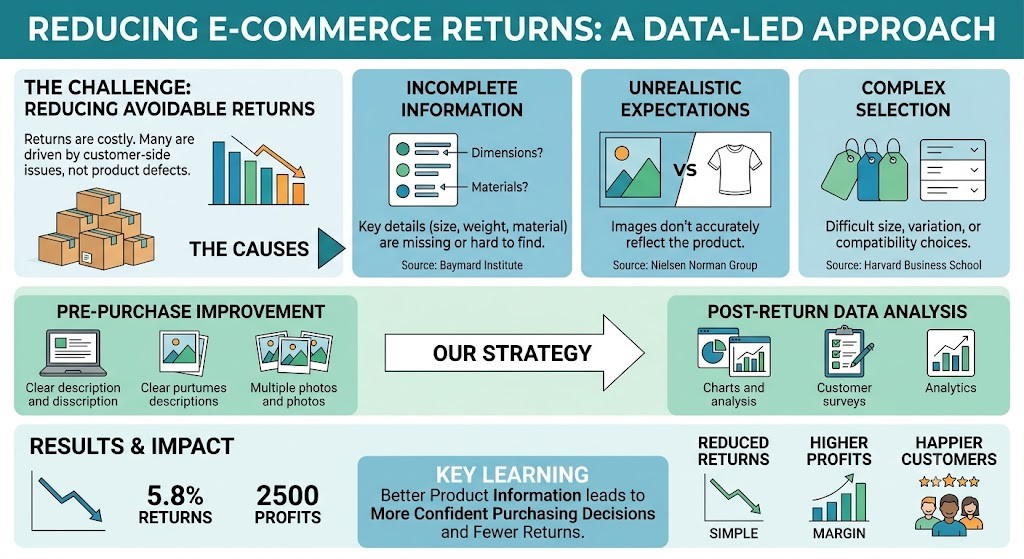
Illustration of the eCommerce product returns challenge, showing the relationship between product information gaps, customer expectations, and return rates
Avoidable returns in eCommerce — the link between pre-purchase information and post-purchase outcomes

The Challenge: A Growing Business with a Growing Returns Problem

The retailer operated a growing online business with a diverse product catalogue spanning homewares, accessories, and lifestyle goods. As the customer base expanded and order volumes increased, so did the volume and cost of product returns.

While a proportion of returns is inevitable in any online retail environment, internal analysis revealed that a significant share of returns was avoidable. These returns were driven not by product defects or genuine dissatisfaction, but by customers receiving something that did not match what they expected or needed when they placed the order.

The consequences extended well beyond the cost of refunds. Each return triggered a chain of operational activity: product inspection, condition grading, inventory updates, restocking decisions, and, in many cases, write-downs on products that could not be resold at full price. The Chartered Institute of Procurement and Supply estimates that the true cost of a return, when all handling and administration is included, can reach two to three times the original outbound fulfilment cost.

Customer service teams were also absorbing the impact, spending a disproportionate amount of their time handling return-related queries, chasing refunds, and managing customer dissatisfaction that could have been avoided.

The retailer recognised that the problem was not primarily a fulfilment or logistics issue. It was a pre-purchase information problem. Customers were making purchasing decisions without the full picture, and the business was bearing the cost.

With the scale and nature of the challenge established, the next step was a structured investigation into what was actually driving avoidable returns across the product catalogue.

Understanding the Causes: What the Data Revealed

The retailer undertook a thorough review of return data, customer feedback, and product page performance before designing any response. This diagnostic phase drew on principles from root cause analysis, a standard approach in operational improvement that focuses on identifying underlying causes rather than treating symptoms. Three recurring themes emerged.

1. Product Information Gaps

A consistent finding across multiple product categories was that product pages lacked the level of detail customers required to make confident purchasing decisions. Key attributes such as dimensions, materials, weight, compatibility requirements, and intended use were either absent, buried within dense descriptions, or presented inconsistently across the catalogue.

Research from the Baymard Institute, one of the leading independent authorities on eCommerce usability, consistently identifies incomplete product information as one of the primary drivers of both cart abandonment and post-purchase returns. Customers who cannot find the information they need before purchase will either abandon the transaction or, if they proceed, face a higher likelihood of disappointment upon delivery.

2. Product Expectation Mismatches

The second theme related to the gap between what customers anticipated and what they received. Customer feedback revealed that product images were often limited to a single angle, failed to convey accurate scale, or did not reflect real-world colour and finish under normal lighting conditions.

The Nielsen Norman Group, a globally respected user experience research organisation, has documented extensively how product photography directly influences purchase confidence and post-purchase satisfaction. Where visuals are inadequate or misleading, the mental model a customer builds before purchase diverges from the product reality, and returns are the predictable result.

3. Sizing and Selection Difficulties

Several product categories required customers to make decisions based on measurements, technical specifications, or product variations such as size, finish, or compatibility. Without sufficient decision-support content, customers frequently selected options that were not the best match for their requirements.

This is a well-documented pattern in e-commerce. Harvard Business School research has noted that when customers face complex choices without adequate guidance, the quality of their decisions deteriorates, and dissatisfaction rises. Clear comparison tools, sizing guidance, and compatibility information are not supplementary niceties; they are functional necessities for high-consideration purchases.

Having identified the core drivers of avoidable returns, the retailer was in a strong position to set clear objectives and design a practical, structured response.

Objectives

The retailer established five clear objectives for the improvement programme:

  • Reduce avoidable product returns across priority product categories by addressing pre-purchase information gaps
  • Improve customer purchase confidence so that buyers can make informed decisions with greater certainty
  • Strengthen the quality and consistency of product content across the catalogue
  • Improve operational efficiency by reducing the volume of return-related processing and customer service activity
  • Increase profitability by lowering the direct and indirect costs associated with avoidable returns

The Strategy: Fixing the Problem Before the Purchase

The retailer's strategy was grounded in a straightforward principle: the best way to reduce returns is to help customers make better decisions before they buy. This reflects a broader shift in eCommerce thinking, documented by organisations such as the World Retail Congress and IMRG, towards pre-purchase experience as the primary lever for return reduction.

Strengthening Product Information

Product descriptions were audited and rewritten across priority categories. The objective was to ensure that every product page answered the questions a customer would reasonably ask before committing to a purchase. This included precise dimensions, materials and finishes, weight, compatibility notes where relevant, and clear descriptions of intended use and product limitations.

Content was reorganised using principles from progressive disclosure, presenting the most decision-critical information prominently and allowing customers to access additional detail without cognitive overload. This approach, well established in UX research, reduces the effort required to reach a confident purchase decision.

Improving Product Visualisation

Product photography was enhanced to provide a more complete and accurate representation of each product. Key improvements included multiple viewing angles, lifestyle context images to convey scale and real-world appearance, close-up detail shots for texture and finish, and consistent lighting and background standards across the catalogue.

The goal was to close the gap between customer expectations and product reality. As Shopify's commerce research and independent studies consistently show, high-quality, multi-angle product imagery is one of the most effective single interventions for reducing return rates in online retail.

Enhancing Sizing and Selection Guidance

For product categories where customers regularly struggled with selection decisions, the retailer introduced structured decision-support content. This included:

  • Detailed sizing guides with measurement references and worked examples
  • Side-by-side product comparison tables for variant-heavy ranges
  • Compatibility checkers and specification matching guidance
  • Practical "how to choose" content integrated directly into product pages

This type of content addresses what behavioural economists describe as choice overload: the tendency for complex decisions made without adequate information to produce suboptimal outcomes and subsequent regret. Structured guidance reduces uncertainty and supports better purchase accuracy.

Using Return Data for Continuous Improvement

The retailer introduced a formalised return data review process, analysing return reasons, product-level return rates, and customer feedback on a regular cycle. This created a feedback loop that allowed the team to identify emerging issues, monitor the impact of content improvements, and prioritise future interventions.

This approach reflects best practices in continuous improvement methodologies, including Plan-Do-Check-Act (PDCA), which is widely applied in retail operations to drive incremental and sustained performance gains.

The strategy was implemented in stages, with priority given to the highest-return product categories. The outcomes across each objective were tracked and measured consistently.

Results: Measurable Improvement Across All Objectives

Reduction in Avoidable Return Rates

Following the implementation of improved product information and enhanced visual content, avoidable return rates fell materially across the priority product categories. Products with the most significant information gaps before the programme saw the sharpest reductions. The data confirmed that customers who had access to complete, well-presented product information before purchase were substantially less likely to return the item.

Improved Customer Purchase Confidence

Customer satisfaction scores and post-purchase survey responses reflected a marked improvement in purchase confidence. Customers reported feeling better informed at the point of decision and more satisfied that the product they received matched what they had expected.

This aligns with findings from PwC's Global Consumer Insights Survey, which consistently identifies accurate and transparent product information as a leading driver of eCommerce customer trust and satisfaction.

Greater Operational Efficiency

Lower return volumes reduced the operational burden significantly. Time spent on product inspection, condition assessment, inventory updates, and return processing decreased in proportion to the reduction in return volumes. Customer service teams reported a measurable reduction in return-related contact, allowing them to focus on higher-value customer interactions.

Improved Profitability

The combined effect of lower return volumes, reduced reverse logistics costs, and lower customer service overhead contributed to a meaningful improvement in the retailer's gross margin. The investment in product content improvements delivered a return that was both measurable and sustained, validating the approach taken.

The results confirm a clear lesson that is supported by research and applicable to any e-commerce business, regardless of sector or scale.

Returns Are a Pre-Purchase Problem

Product returns are often treated as a logistics or fulfilment challenge, something to be managed efficiently after the fact. This case study demonstrates that the more productive approach is to treat returns as a pre-purchase information and guidance challenge, and to invest accordingly.

When customers have access to accurate, complete, and well-presented product information before they buy, they make better decisions. Better decisions mean fewer surprises upon delivery, fewer returns, and better outcomes for both the customer and the retailer.

The quality of a decision is proportional to the quality of information available

The retailer's experience reinforces a principle that is well established in e-commerce best practice literature: the quality of a customer's purchasing decision is directly proportional to the quality of information available to them at the point of choice. Investing in that information is not a marketing exercise — it is an operational and financial strategy with a demonstrable return. For eCommerce businesses looking to address return rates, the starting point is not the returns portal or the reverse logistics network. It is the product page.